
Best AI Tools for Malaysian Freelancers in 2026
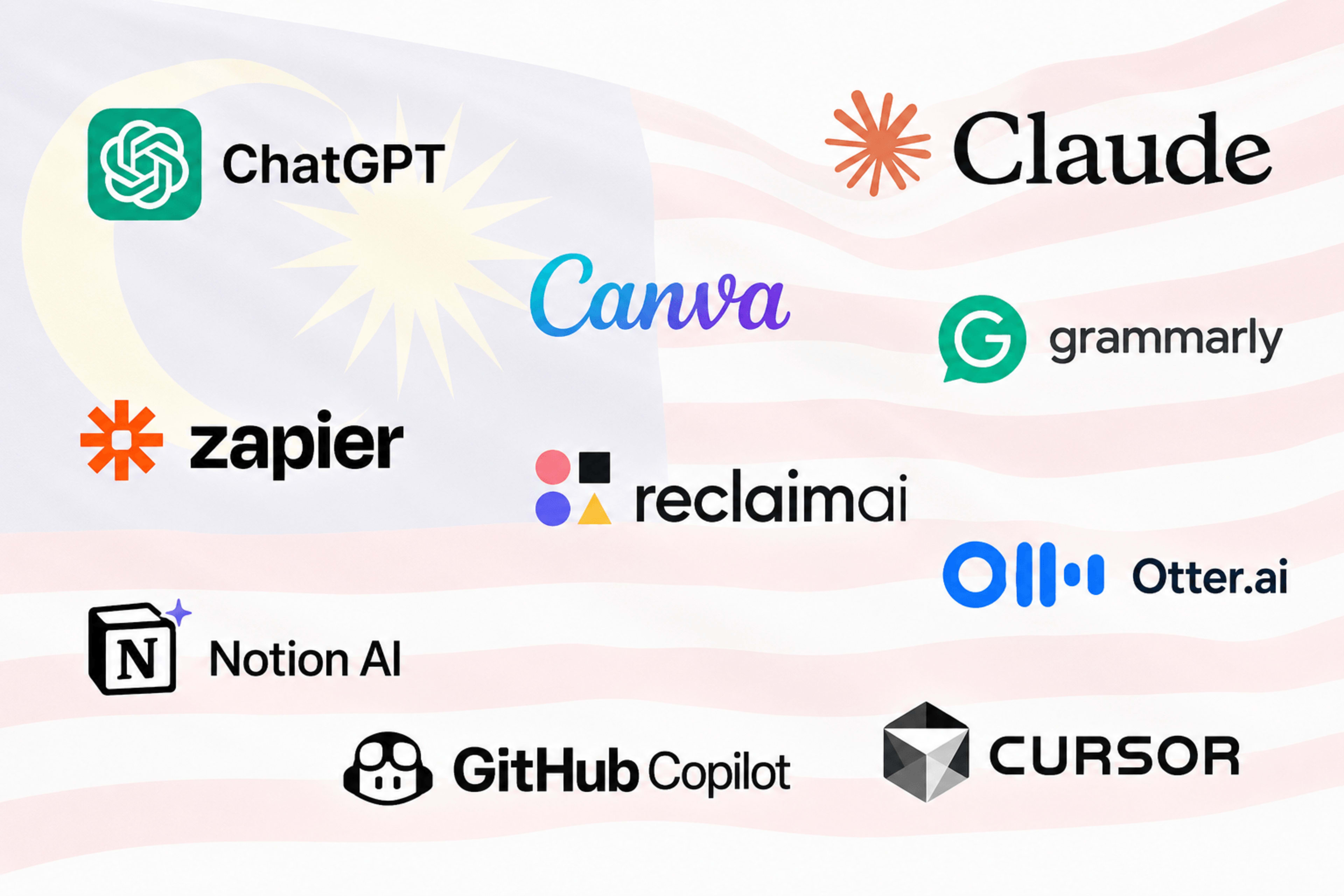
- 76% of freelancers use AI, saving about 8.1 hours per week; AI-enabled freelancers earn roughly 40% more per hour. Use two or three tools well, not fifteen.
- Core stack: ChatGPT (Go RM24/month is Malaysia's best AI value; Plus RM99), Claude Pro (~RM85, best for long documents — now includes Claude Code), Canva Pro (RM250/year).
- By niche: Grammarly Pro ~RM49 and Surfer SEO from ~RM200 for writers; GitHub Copilot ~RM41 or Claude Code for developers; Otter.ai ~RM34 for calls; Zapier ~RM82 for automation. Skip Notion AI unless you're willing to pay RM82/month for the Business plan — the cheap add-on is gone.
- Budget: under RM5k income, spend RM0–24. RM5k–15k, spend RM140–205. RM15k+, spend RM340–430. Most tools bill in USD, so keep 10–15% headroom for forex and SST.
- The real shift: Charge for outcomes instead of hours, learn to brief AI agents on whole workflows, and move toward judgment-heavy work — that's where 2026 earnings are growing.
Here's a stat that should grab your attention: 76% of freelancers now use AI tools, and those who do save an average of 8.1 hours a week, according to Fiverr's 2026 freelancing report.
That's a full working day back every week.
A day you could spend on another paying project, or honestly, just living your life outside your laptop. Freelancer.com's global survey adds a second number worth knowing: freelancers who work with AI report earning around 40% more per hour than those who don't.
But here's where most Malaysian freelancers get it wrong.
They sign up for ten to fifteen different AI tools, pay for subscriptions they barely use, and end up more overwhelmed than productive. The freelancers winning in 2026 aren't the ones using the most AI tools. They're the ones who use two or three tools well, focusing on the tasks that take the most time in their specific workflow.
One more thing has changed since early 2026.
The Pricing.
OpenAI now bills Malaysians directly in ringgit and has been cutting prices. At the same time, most other tools still charge in US dollars, which means the ringgit's movement (around RM4.10 to the dollar in August 2026) and Malaysia's 8% service tax on foreign digital services quietly affect your monthly bill.
I've priced everything below accordingly.
Let me show you what actually works.
What AI Can and Can't Do for You
Before we get into specific tools, let's be honest about what AI does well and where it falls short.
AI is good at: First drafts, brainstorming, data organization, repetitive formatting, research summaries, code scaffolding, image generation, scheduling automation, and — new in 2026 — running multi-step "agent" tasks like researching a topic across dozens of sources or executing a coding task end to end.
AI struggles with: Original strategic thinking, nuanced cultural context (especially the Malaysian context), fact-checking itself, understanding client relationships, and producing work that doesn't require human editing.
The sweet spot?
Use AI to handle the 60% of your work that's repetitive, then spend your brain power on the 40% that actually requires your expertise.
Upwork's 2026 Future Workforce Index also supports it.
Earnings for freelancers doing complex, judgment-heavy work with AI rose 45% in Q1 2026, while purely repetitive execution work is losing value.
AI isn't replacing freelancers.
It's repricing them.
The Essential AI Stack (Every Freelancer Needs These)
ChatGPT
Cost: ChatGPT Go RM24/month, ChatGPT Plus RM99/month
Best for: Writing, research, coding, client communication, brainstorming
ChatGPT remains the Swiss Army knife of AI tools, and the biggest news for Malaysian freelancers is at the bottom of the price list, not the top.
In late 2025, OpenAI launched local ringgit billing, and in February 2026 it cut the entry-level ChatGPT plan to RM24/month from RM38.99/month. ChatGPT Go gives you extended access to the flagship GPT-5 models with higher message limits, more image generation, and bigger file uploads.
For a freelancer just starting with AI, RM24 is very easy money to make back.
ChatGPT Plus at RM99/month adds advanced tools for deep research, Sora video generation, and much higher usage limits. There's also a Pro tier at RM420/month (cut from RM999 in April 2026), but that's built for power users running AI agents all day; most freelancers don't need it.
For Malaysian work specifically, GPT-5 handles Bahasa Malaysia noticeably better than the GPT-4-era models did, though you'll still want to review for natural phrasing. ChatGPT is most powerful as an ideation and research partner where you throw a client brief at it and ask for ten angle ideas. You'll use three or four, but that brainstorming session that used to take 45 minutes now takes five.
Real-world use case: A KL-based copywriter uses ChatGPT to generate first drafts, then spends her time on editing and adding the Malaysian context that AI consistently misses. She went from producing three client deliverables per week to five, without working long hours. That's a great increase in productivity.
Claude Pro
Cost: US$20/month, roughly RM85 after conversion and SST (about US$17/month billed annually).
Best for: Long documents, editing, nuanced analysis, complex reasoning, and coding.
Claude beats ChatGPT for anything involving long documents.
If you're a freelance consultant writing 20-page reports, a content writer producing in-depth guides, or a researcher analyzing multiple documents, Claude's ability to process and reason over extended content is significantly better.
It also handles Bahasa Malaysia, English, and Chinese well, and switches between them mid-conversation.
Two things have changed since early 2026.
First, Claude Pro now includes Claude Code, Anthropic's agentic coding tool, so one RM85 subscription covers both your writing and serious coding assistance. That changes the value calculation for anyone technical.
Second, Anthropic still bills you in US dollars, so your card statement moves with the exchange rate and reflects the 8% SST plus any bank forex markup. Some Malaysian cards decline recurring USD charges; subscribing through the App Store or Google Play, or using a multi-currency card like Wise or BigPay, usually solves it.
When to use Claude over ChatGPT: Complex editing tasks, comparing multiple documents, writing content that requires sustained logical reasoning, coding, and any job where you need the AI to keep track of information across a long conversation.
Canva AI
Cost: Free tier available; Canva Pro RM250/year (about RM21/month; monthly billing is more expensive at around RM37).
Best for: Social media graphics, presentations, marketing materials.
If you're a non-designer freelancer who still needs to produce visual content like pitch decks, social media posts, infographics, Canva's AI features have eliminated the need to outsource basic design work.
Canva bills in local Malaysian currency, which makes it one of the easiest subscriptions on this list to budget for.
Take the annual plan; the monthly rate is poor value by comparison.
- Magic Design generates entire layouts from a text prompt.
- Background Remover handles product photos in seconds — a big deal if you shoot products for Shopee or TikTok Shop clients.
- Magic Write generates copy directly within your designs.
For Malaysian freelancers creating Hari Raya campaigns, CNY graphics, or Merdeka content, the template library includes culturally relevant options.
Specialist AI Tools (Pick What Fits Your Workflow)
For Writers and Content Creators
Grammarly Pro
Cost: US$12/month billed annually (about RM49); US$30 on monthly billing
A heads-up first: Grammarly's parent company rebranded as Superhuman in October 2025, bundling Grammarly with the Superhuman Mail email client and Superhuman Docs.
The writing product still works the same.
The AI-powered rewrite suggestions, tone detection, and plagiarism checker are worth it for any freelancer whose deliverables involve writing, but note the significant gap between annual and monthly billing.
Pay yearly or don't bother.
Surfer SEO

Cost: from US$49/month (about RM200)
If you write SEO content for clients, Surfer's content editor tells you exactly which keywords to include, optimal word count, and heading structure based on what's currently ranking.
Surfer renamed its plans in 2026; the entry Discovery tier is now US$49/month billed yearly, with the Standard plan at US$99, and every plan now includes AI visibility tracking, showing whether your content gets cited in ChatGPT, Perplexity, and Google AI Overviews.
That matters more every month, because clients are starting to ask about AI search visibility, not just Google rankings.
Still the priciest tool in its niche, but it pays for itself if you charge for SEO content.
Descript
Cost: Free tier (1 hour), Creator plan US$15/month (about RM61)
For freelance video editors and podcasters, Descript lets you edit audio and video by editing text. Literally delete a word from the transcript, and it cuts the video. The AI-powered filler-word removal and studio-sound features save hours of manual audio cleanup.
For Developers and Tech Freelancers
The developer AI market has moved faster than any other category, so this section looks quite different from what it did six months ago.
GitHub Copilot

Cost: Free tier available, Pro US$10/month (about RM41)
Copilot now has a genuinely usable free tier (2,000 code completions and 50 premium requests a month). The Pro plan remains the cheapest paid entry point in AI coding.
One change to know: In June 2026, GitHub switched premium features to usage-based "AI Credits", where code completions stay unlimited on paid plans, but chat and agent sessions draw from a monthly credit pool.
Light users won't notice. Heavy agent users will.
Claude Code
Cost: included with Claude Pro (US$20/month)
The tool that has changed freelance development work most this year.
Claude Code runs in your terminal or editor, takes a task, and works through it across your entire codebase, including writing, testing, and fixing. If you're already paying for Claude Pro for writing work, you get this at no extra cost, which is why many freelance developers have consolidated onto a single Claude subscription instead of stacking tools.
Cursor

Cost: Free tier, Pro US$20/month (about RM82)
The AI-first code editor is now a mainstream choice rather than an upstart.
It integrates AI directly into the coding experience, and for complex refactoring or understanding unfamiliar codebases, its "chat with your code" workflow is remarkably useful. Cursor itself says daily agent users typically need the US$60 Pro+ tier,
So budget honestly if you'll lean on it hard.
My take for Malaysian developers on a budget: Start with Copilot Free plus the free tiers of Claude or ChatGPT, then upgrade whichever one reaches its limits first. That tells you which tool your actual workflow values.
For Business and Client Management
Notion AI
Cost: Business plan at US$20/user/month (about RM82)
This one needs a warning label.
Notion killed its US$10 AI add-on in May 2025.
Full Notion AI, the agent, AI meeting notes, workspace search. It is now bundled only into the Business plan, and the Free and Pro tiers get a limited trial.
If you already run your freelance operation in Notion and want AI inside it, RM82/month buys a lot of capability.
If you only wanted the AI, that money is better spent on ChatGPT Plus or Claude Pro, which do more for the same price.
Otter.ai
Cost: Free tier (300 minutes/month), Pro US$8.33/month billed annually (about RM34)
Automated meeting transcription with AI summaries.
If you attend client calls on Zoom or Google Meet, Otter transcribes everything and generates action items. No more scrambling to take notes during calls while trying to sound engaged.
The free tier's 300 monthly minutes genuinely covers a light client load.
Automation and Workflow Tools
Zapier
Coat: Free tier, starts from US$19.99/month billed annually (about RM82)
Zapier connects your different apps and automates workflows.
Its Copilot now lets you build automations in plain English: "When a new invoice is created in my accounting software, send a WhatsApp message to the client."
The free tier covers 100 tasks a month with simple two-step Zaps; the first paid tier includes tasks and multi-step workflows.
For Malaysian freelancers, the most valuable automations include automated invoice follow-ups (critical for managing local clients who tend to pay on Malaysian time), new lead notifications, and social media scheduling.
One important aspect to consider: Zapier charges per step, and premium apps burn tasks fast. Make sure to check your task usage in month one before committing to a year.
Reclaim.ai
Cost: Free tier, Starter plan at US$10/month billed annually (about RM41)
Reclaim AI is an AI-powered calendar tool, now owned by Dropbox, that automatically schedules your tasks, habits, and breaks around your meetings.
It protects your deep work time and reschedules automatically when things change. For freelancers juggling multiple clients across different time zones, it's common when you serve both Malaysian and international clients.
This removes a surprising amount of daily friction. The free Lite plan is real but limited to a one-week scheduling window and one calendar, so treat it as a test drive.
The Malaysian Freelancer's AI Budget Guide
You don't need all of these tools.
Here are my recommendations by income level, using the latest pricing (August 2026)
Starting (Earning under RM5,000/month)
| Tool | Cost | Why |
|---|---|---|
| ChatGPT Free or Go | RM0–24 | Brainstorming and first drafts |
| Canva Free | RM0 | Basic design needs |
| Grammarly Free | RM0 | Writing quality check |
| Total | RM0–24 |
You can still start with zero AI spending.
The free tiers are genuinely useful. But the RM24 for the ChatGPT Go plan is the best value in Malaysian AI right now. It exists partly because Google's competing AI Plus bundle costs RM23.99.
The price war works in your favor.
Beyond that, focus your money on skill development rather than tools.
Growing (RM5,000–RM15,000/month)
| Tool | Cost | Why |
|---|---|---|
| ChatGPT Plus or Claude Pro | RM85–99 | Full AI capabilities |
| Canva Pro (annual) | RM21 | Professional designs |
| One specialist tool | RM34–85 | Based on your niche |
| Total | RM140–205 |
At this level, the investment pays for itself if it saves you even five hours per month.
Five hours at RM100/hour is RM500 in recouped billing time.
Pick ChatGPT Plus or Claude Pro, not both, as the overlap is large, and Claude Pro's included Claude Code tilts the choice for anyone technical.
Established (RM15,000+/month)
| Tool | Cost | Why |
|---|---|---|
| ChatGPT Plus | RM99 | All-rounder, deep research |
| Claude Pro | RM85 | Complex work + Claude Code |
| Two specialist tools | RM75–160 | Niche-specific |
| Zapier (annual) | RM82 | Automation |
| Total | RM341–426 |
When you're earning RM15,000+, spending around RM400/month on tools that save 8–10 hours weekly is an easy investment to justify.
One budgeting note: apart from ChatGPT and Canva, everything here is billed in dollars, so leave 10–15% headroom in your tools budget for exchange rate movements and card fees.
How to Actually Get Productive With AI
Here's the framework that separates freelancers who waste time with AI from those who genuinely benefit:
Step 1: Audit your time for one week.
Track every task and how long it takes. Identify the top three tasks that consume the most time relative to the value they produce.
Step 2: Match one AI tool to each time-sink.
Don't try to AI-ify everything. Start with the three biggest time-wasters.
Step 3: Create templates and prompts.
The real power of AI isn't in ad-hoc use. It's in systematic prompts you reuse.
Build a prompt library for your recurring tasks: client proposals, project updates, social media posts, nd invoice reminders.
Step 4: Review and improve every two weeks.
Which AI tasks actually saved time?
Which ones created more work through poor outputs you had to redo?
Cut what doesn't work. Double down on what does.
The Elephant in the Room: AI and Your Clients
Should you tell your clients you use AI?
If you ask me, transparency builds trust.
Most clients in 2026 are aware and expect freelancers to use AI tools. It's like expecting a designer to use Photoshop.
What clients care about is the quality of the final deliverable, not whether an AI generated the first draft.
However, never pass off raw AI output as your own work. Malaysian clients are savvy enough now to spot AI-generated content, and nothing destroys trust faster than lazy, unedited AI output with a premium invoice attached.
There's also a pricing angle most freelancers miss.
If AI cuts a ten-hour project to four hours and you bill hourly, you just gave yourself a pay cut. The freelancers capturing AI's value in 2026 are moving to fixed-price and value-based quotes, charging for outcomes.
Upwork's data shows the earnings premium for AI-augmented freelancers comes from this shift, not from billing more hours.
The winning approach: "I use AI tools to accelerate my workflow, which allows me to deliver higher quality work in less time. Every deliverable goes through my personal review and refinement process."
What's Coming Next
Keep an eye on these developments for Malaysian freelancers.
Local pricing is spreading.
OpenAI and Google now bill in the local currency, Ringgit Malaysia, and are undercutting each other. Revenue has begun rolling out local-currency pricing in markets such as India.
If ringgit billing reaches more tools, the exchange-rate headache in your budget shrinks.
Agentic AI is becoming the divide.
The gap in 2026 isn't between freelancers who use AI and those who don't. It's between those using AI one prompt at a time and those delegating whole workflows to agents like Claude Code, deep research modes, and Zapier's AI.
Learning to brief an agent well is the new skill worth an afternoon of practice.
The market is repricing work, fast.
Upwork's 2026 index found the share of skilled knowledge workers who freelance jumped from 28% to 38% in a single year, with AI-augmented professional services growing 72% year on year.
The opportunity isn't about using AI to do the same work more cheaply; it's about using AI to sell work that wasn't economically viable before.
A detailed competitor analysis for SME clients, personalized marketing at scale, and multilingual content production are among the complex tasks completed promptly using AI tools.
This is where the AI-assisted freelancing market in Malaysia is heading.
Frequently Asked Questions
What is the best AI tool for freelancers in Malaysia?
For freelancers on a tight budget, ChatGPT Go (RM24/month) is the best value in Malaysia in 2026 — local-currency billing (Ringgit Malaysia) and access to GPT-5 for the price of two mamak sessions.
For full capability, ChatGPT Plus (RM99/month) is the best all-rounder, while Claude Pro (about RM85/month) is stronger for long documents, complex editing, and coding, since it includes Claude Code.
Can AI tools really save freelancers 8–10 hours a week?
Yes, for most freelancers.
Fiverr's 2026 report found that freelancers using AI have an average of 8.1 hours per week, and 64% report a measurable increase in productivity. A content writer who typically produces a 1,000-word blog post in 3 hours can complete it in 90 minutes with AI assistance. The key is to target your most time-consuming repetitive tasks rather than using it for everything.
Are there free AI tools that are good enough for freelancers?
Absolutely.
The free tiers of ChatGPT, Claude, Canva, Grammarly, Otter.ai, and even GitHub Copilot provide genuine productivity value in 2026. Freelancers earning under RM5,000/month can build an effective AI workflow at zero cost — or nearly zero, since ChatGPT Go at RM24/month removes most free-tier limits for less than the price of a streaming subscription.
Should I tell my clients I use AI tools?
Yes, transparency is recommended. Most Malaysian clients in 2026 expect freelancers to use AI tools — the question is whether you're using them professionally. Never pass off raw, unedited AI output as your own work. Instead, position AI as a workflow accelerator: "I use AI tools to enhance my research and drafting process, but every deliverable is personally reviewed and refined to ensure quality."
Will AI tools replace the need for freelancers?
No, but they are changing which freelancers earn well. Upwork's 2026 Future Workforce Index shows earnings rising for freelancers doing complex, judgment-driven work with AI (up 45% in Q1 2026), while purely repetitive execution work loses value.
Freelancer.com's data shows that enabled freelancers earn nearly 40% more per hour. The freelancers at risk are those doing work that AI handles well end-to-end. Specialists who combine AI efficiency with human expertise are earning more than ever.



Comments