
Malaysia's Gig Workers Act 2025: What You Should Know

If you've been freelancing in Malaysia for the past decade, you've probably gotten used to working in a bit of a grey area.
No mandatory benefits, flexible arrangements with clients, and the kind of independence that makes office work feel like a prison sentence.
That's about to change in a big way.
Malaysia's new Gig Workers Act—officially taking effect in 2026—is the biggest regulatory shift for freelancers and gig economy workers in years.
It brings mandatory SOCSO coverage, enhanced EPF options, new rights under service agreements, and dispute-resolution mechanisms.
If you're earning money through gig work in Malaysia, this affects you.
Here's what you actually need to know, without the bureaucratic nonsense.
What Is the Gig Workers Act?
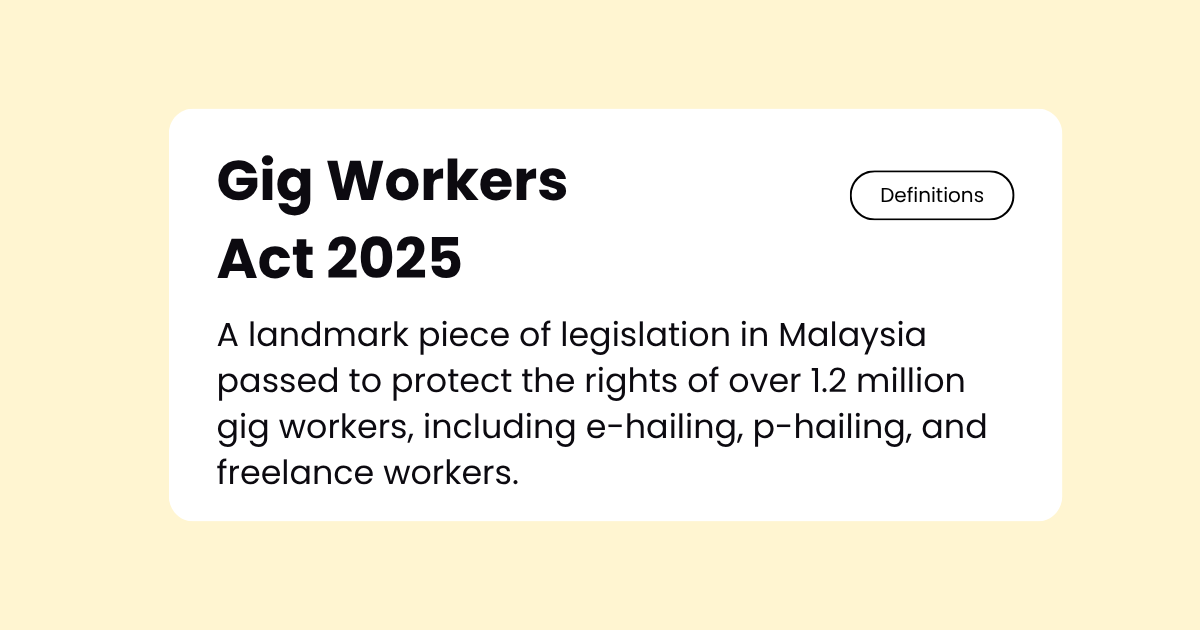
The Gig Workers Act is Malaysia's first comprehensive law specifically designed to protect workers in the gig economy.
Think of it as a legal safety net that was designed to apply to traditional employment, but now applies to people who work project-by-project or task-by-task for multiple clients.
Here's the thing: the gig economy was growing so fast that Malaysia's existing employment laws couldn't keep up. So the government stepped in with targeted protections that make sense for freelancers, digital creators, ride-share drivers, delivery workers, and other gig-based earners.
The Act officially took effect in 2025 and is being fully implemented throughout 2026, with January 1st, 2026, marking the mandatory compliance date for most provisions.
Who's Covered? The Legal Definition of 'Gig Worker'
Not every freelancer is a 'gig worker' under this Act. The definition is specific.
Under the Gig Workers Act, you're classified as a gig worker if you:
- Work for one or more platform operators or service recipients on a task-by-task or project-based basis
- Have some control over when, where, and how you work (but not complete autonomy)
- Are not considered a permanent employee of any single organisation
- Earn income directly or through a platform intermediary
So if you're freelancing as a writer, designer, developer, marketer, or consultant—especially through platforms like Upwork, Fiverr, or direct client arrangements—you likely fall under this definition.
However, digital creators on YouTube or content creators on TikTok are treated slightly differently, which we'll cover later.
Mandatory SOCSO Coverage: What It Means and How to Enroll

This is the biggest change. SOCSO (Pertubuhan Keselamatan Sosial) is Malaysia's social security organisation, and as of 2026, gig workers must be enrolled in SOCSO coverage.
Before the Gig Workers Act, SOCSO was mainly for permanent employees. Freelancers were on their own—if you got injured or fell ill, there was no safety net.
Now, here's what SOCSO covers for gig workers:
- Work-related injuries and occupational diseases
- Temporary and permanent disability
- Survivor benefits for dependents if the worker passes away
How to enroll:
The process is straightforward. Most platforms (Grab, Foodpanda, Upwork Malaysia partners, etc.) are responsible for registering their workers.
If you're working directly with clients, you'll need to register yourself with SOCSO. You can do this online at the SOCSO portal or through their office.
Contributions are based on your monthly earnings, with both you and your 'service recipient' (the platform or client) paying a percentage of your earnings. The exact rate will depend on your income level and the type of work.
Enhanced EPF: i-Saraan Plus Matching Incentives
Alongside SOCSO, the government is also encouraging gig workers to save for retirement through an enhanced EPF (Employees Provident Fund) scheme called i-Saraan Plus.
Here's the bonus: the government offers matching contributions. If you contribute to i-Saraan Plus, the government will match a portion of your contribution, up to a certain limit. This is free money for your retirement.
How it works:
You voluntarily contribute a percentage of your monthly earnings. The government then adds its own contribution on top. The money sits in your EPF account, earning compound returns until you retire.
You can enroll through the EPF portal, and contributions are deducted based on your declared monthly income.
It's completely voluntary, but from a financial standpoint, it's hard to turn down free matching contributions.
Service Agreement Requirements: What Must Be in Writing
The Gig Workers Act requires that the terms of engagement between gig workers and service recipients (your clients or platforms) be documented in a service agreement.
This doesn't necessarily mean a 20-page legal document. Agreements can be written, oral, or even documented via email or messaging platforms.
What matters is that the essential terms are clear.
A valid service agreement must include:
- Nature and scope of the work
- Payment terms and rates
- Duration of the arrangement (if applicable)
- Working conditions and safety requirements
- Dispute resolution procedures
If you're doing a quick project through Upwork, your agreement is already documented by the platform's terms and the milestone descriptions.
If you're working directly with a client, have a conversation and put key terms in an email—screenshot it or save it. That counts.
The goal isn't to create bureaucracy; it's to protect both you and your client by ensuring everyone's on the same page about expectations, payment, and what happens if something goes wrong.
New Dispute Resolution: How to Handle Payment and Contract Issues

One of the most useful provisions in the Gig Workers Act is a formal dispute resolution mechanism. In the past, if a client didn't pay or disputes arose, you had very limited options.
Now, the Act establishes a three-tier approach:
- Internal resolution: First, try to resolve disputes directly with your client or platform
- Mediation: If that fails, you can request mediation through a government-designated mediator
- Arbitration: If mediation doesn't work, you can proceed to binding arbitration
This process is much faster and cheaper than filing a lawsuit. You can dispute non-payment, unfair contract terms, or wrongful termination of a working relationship.
The government has published a procedure and timeline for these disputes, so there's actual structure and accountability now.
What Employers and Clients Must Do: Their Obligations
If you're a client or platform using gig workers, the Act places obligations on you. Here's what you must do:
- Register gig workers with SOCSO and contribute to their coverage
- Ensure service agreements are in place with clear terms
- Pay on time and in full as per the agreed terms
- Provide safe working conditions and necessary equipment
- Maintain records of work assignments and payments
- Respond to disputes within a reasonable timeframe
For individual freelancers working with one-off clients, this is mostly good news. For platforms and established agencies, it means more administrative responsibility—but also clearer rules of engagement.
Transitioning Your Existing Arrangements: Practical Steps
If you're already freelancing, you don't need to panic. The transition to the new rules is built in, and most platforms are actively working on compliance.
Here's what to do right now:
- Check if your platform has already enrolled you in SOCSO (most have)
- Review the updated terms and conditions on any platforms you use
- If you're working directly with clients, document key terms in writing (even a simple email works)
- Consider enrolling in i-Saraan Plus for the government matching contributions
- Keep records of all work assignments and payments
Existing arrangements don't suddenly become invalid. You won't be kicked off a platform you're already on. Instead, the new rules layer on top of what exists, creating a clearer framework moving forward.
Penalties for Non-Compliance: What Happens if the Rules Aren't Followed
The Gig Workers Act has teeth. Service recipients (platforms and clients) who don't comply face penalties.
Violations can result in:
- Fines up to RM 50,000 for first offence
- Fines up to RM 100,000 for subsequent offences
- Mandatory SOCSO and back-payment obligations
- Loss of platform license in serious cases
For individual gig workers, penalties are minimal—the law protects you, not punishes you. However, if you misrepresent your income or fail to register when required, you could face minor fines.
The bigger impact comes from losing access to SOCSO protections.
Digital Freelancers vs. Gig Workers: How the Act Treats Different Types
Here's a nuance that confuses a lot of people. The Gig Workers Act applies to most types of gig work, but digital creators (e.g., YouTubers, Twitch streamers, TikTok creators) are treated differently.
If your primary income is from content monetisation (ad revenue, sponsorships) rather than being paid directly for a service or task, the Act's mandatory SOCSO provisions may not apply the same way. However, if you're being paid directly by brands or platforms for content work, those payments could still trigger SOCSO obligations.
The distinction comes down to: Are you being paid for specific work/services, or for content ownership and audience?
If you're a digital creator, the safest approach is to voluntarily register for SOCSO. The i-Saraan Plus scheme is also available to digital entrepreneurs, and it's a smart financial move regardless of your legal classification.
FAQ: Your Most Pressing Questions Answered
Q1: Do I have to use a specific platform to get SOCSO coverage?
No. SOCSO coverage is mandatory for any gig work in Malaysia, whether you're using Upwork, Grab, Foodpanda, Fiverr, or working directly with private clients. Larger platforms (especially ride-share and delivery apps) are already handling enrollment automatically. If you're self-employed doing freelance work, you can register directly with SOCSO online or visit an office.
Q2: How much will SOCSO cost me?
SOCSO contributions are based on your declared monthly income and are shared between you and the service recipient (platform or client). The exact percentage varies, but for gig workers earning RM 1,500–RM 3,000 per month, expect to contribute roughly 0.5-1% of your income, with the service recipient matching that amount. Platforms will deduct your share from your earnings automatically.
Q3: What if I'm already covered under another employment scheme?
If you have a permanent job and freelance on the side, your SOCSO coverage for your permanent job is separate from your gig work coverage. You'll need to register for the Gig Workers Act SOCSO scheme for your freelance income. This actually provides layered protection—if something happens, you're covered under both schemes.
Q4: Can clients opt out of SOCSO contributions?
No. SOCSO enrollment and contributions are mandatory under the Gig Workers Act. Clients and platforms cannot legally opt out or ask you to forgo coverage to reduce their costs. If a client tries to avoid SOCSO obligations, that's a violation of the Act, and you can report it to the Department of Labour or file a complaint through the dispute resolution mechanism.
Conclusion: What Changes for You in 2026
Malaysia's Gig Workers Act 2026 represents a fundamental shift in how freelancers and gig economy workers are protected. For the first time, you have legal rights around safety, payment, disputes, and retirement savings.
If you're a freelancer, the practical impact is significant:
- You're automatically enrolled in SOCSO, providing injury and disability protection
- You have access to i-Saraan Plus matching contributions for retirement savings
- Your agreements with clients must be documented and fair
- You have a formal process to resolve payment disputes and contract issues
Yes, there's more paperwork and administrative responsibility.
Yes, there are contributions taken from your earnings.
But here's the thing: you're finally getting the same baseline protections that permanent employees have had for decades.
For freelancers in Malaysia, especially those working across multiple platforms or with corporate clients, this is a net positive.
You're no longer operating in a legal grey zone.
You have rights, recourse, and a safety net.
The Gig Workers Act 2026 isn't the end of freelancing flexibility—it's the beginning of freelancing with actual worker protection.
And that's a change worth understanding.




Comments